
Address rat activity in an attic by assessing accessible areas, discussing chemical-free trapping and proofing, monitoring activity and following cleanup precautions. The sequence and timing depend on the findings at the home. Proofing addresses identified accessible openings; no permanent result or discovery of every opening is promised.
If you’re hearing scratching, scurrying, or gnawing sounds above your ceiling at night, there’s a good chance rats have made your attic their home. Getting rid of them isn’t just about setting a trap — it takes a specific sequence done in the right order, or the rats return (or worse, die inside your walls and leave a much bigger problem).
This guide explains how to identify rat activity, assess accessible entry points, trap rats and reduce re-entry risk. Roof rats occur in the regions RCI serves, but an inspection is needed to assess the activity at your home. See our guide to scratching noises in the attic at night.
What Kind of Rats Are in California Attics?
California has two primary rat species, and knowing which one you have changes your approach:
- Roof rats (Rattus rattus) are the most common attic invader in Southern California and the Bay Area. They’re excellent climbers that prefer elevated spaces — attics, rafters, palm trees, and the tops of walls. They’re sleek, with large ears and a tail longer than their body, and they cause the vast majority of attic infestations in Los Angeles, Orange County, and coastal California.
- Norway rats (Rattus norvegicus) are bulkier and tend to burrow near foundations, under decks, and in lower areas. If rats are in your attic, roof rats are almost certainly the culprits.
This matters because roof rats travel along specific paths — utility lines, fences, and tree branches — to reach your roof. Understanding that behavior changes how you seal entry points and place traps. (If you’re still unsure whether it’s rats or mice, here’s how to tell mice and rats apart.)
Step 1: Confirm You Have Rats (Not Mice or Squirrels)
Before spending money on traps or calling a professional, confirm what you’re dealing with. Signs of rats in the attic include:
- Scratching or running sounds at night (rats are nocturnal, most active between dusk and dawn)
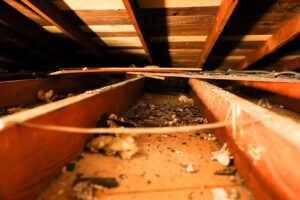
- Droppings 0.5–0.75 inches long, capsule-shaped with pointed ends (larger than mouse droppings, smaller than squirrel droppings)
- Gnaw marks on wood beams, insulation, or electrical wiring
- Nests made from shredded insulation, paper, or fabric
- Grease marks along rafters and beams where rats travel repeatedly
- A strong ammonia smell from accumulated urine
Hearing heavy thumping during the daytime? You may have squirrels instead — squirrels are active by day, rats by night. For a fuller checklist, see the signs of a rodent infestation many homeowners miss.
Step 2: Find How They Got In (Entry-Point Inspection)
This is the step most homeowners skip — and the reason rats keep coming back. You can trap every rat in your attic, but if the entry point is still open, new rats move in within days. Common rat entry points on California homes:
- Gaps where the roofline meets the eaves (fascia boards, soffits)
- Unsealed holes around plumbing pipes and electrical conduit
- Damaged or missing vent covers (gable vents, roof vents, crawlspace vents)
- Gaps around HVAC lines
- Openings where utility cables (cable TV, internet) enter the building
- Spaces between the chimney and surrounding structure
- Any gap larger than a half inch — roof rats compress their bodies to fit through surprisingly small openings
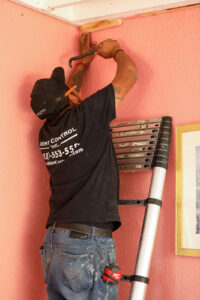
How to inspect: Go outside at dusk with a flashlight and scan your roofline for any gap, crack, or opening. Inside, get into the attic during daylight and look for pinpoints of daylight coming through — each one is a potential entry point.
Step 3: Coordinate Trapping and Accessible Entry-Point Repairs
Trapping and exclusion should be coordinated according to observed activity, accessible areas, and the approved scope. Closing an active opening without considering rats already inside can complicate removal. A professional inspection can help determine the appropriate sequence of work.
Suitable materials depend on the location, ventilation needs, and building condition. Common exclusion materials include:
- Hardware cloth (1/4-inch galvanized mesh) for larger gaps and vent openings
- Copper mesh for pipe penetrations (steel wool works temporarily but rusts)
- Expandable foam plus hardware cloth for irregular gaps
- Sheet-metal flashing for roofline gaps
- Commercial-grade vent covers rated for rodent exclusion
Do not use spray foam alone — rats can chew through it. Professional rodent exclusion focuses on identifying and sealing accessible entry points included in the approved work.
Step 4: Trap the Rats
Once entry points are sealed except for one monitored exit, begin trapping. Three practical approaches:
Snap Traps (Recommended)
Snap traps can be part of chemical-free rat removal. They can injure people or pets, so placement, access control and regular checks matter. Follow the trap manufacturer’s instructions and ask your technician about precautions for your household. RCI recommends trapping and proofing based on the findings at an eligible detached, single-family home.
Live Traps
Live traps catch rats without killing them, but relocation doesn’t solve the problem — released rats often return or die in unfamiliar territory. Most professionals don’t recommend live-capture-and-release for attic infestations.
Rodenticide (Poison Baits)
Rodent Control Inc does not recommend rodenticides in attics or enclosed spaces, for one critical reason: poisoned rats rarely die at the bait station. They return to nesting areas inside your walls or attic and die there, creating a dead-rodent odor that can last weeks. Poison also poses secondary-poisoning risks to owls, hawks, cats, and dogs. If a company recommends attic rat poison with no plan for carcass retrieval and sealing, that’s a red flag.
Step 5: Remove Rats and Monitor
Check traps every 24–48 hours. Wear disposable gloves when handling dead rats and place carcasses in sealed plastic bags before disposal. Keep trapping until you go a full week with zero catches and no fresh droppings — fresh droppings are dark and moist, while old droppings turn gray and crumble. Still finding fresh droppings after a week of no catches? You likely have an unsealed opening. Once trapping is complete, seal the remaining entry point.
Step 6: Clean and Sanitize the Attic
Cleanup recommendations depend on the conditions documented during inspection. Do not sweep or vacuum rodent droppings, urine or nesting materials before following the recommended disinfection steps. Follow the CDC instructions for cleaning up after rodents; extensive contamination may require professional cleanup. Recommended attic cleanup, insulation removal or replacement is discussed in the verbal estimate on site. Approved work and warranty terms follow the signed invoice; an itemized written quote is not promised.
Discuss rodent-related contamination and damaged insulation during the inspection. Any cleanup or insulation work depends on the findings and approved scope.
Step 7: Prevent Rats From Returning
After the infestation is gone and the attic is clean, prevention becomes the priority. Landscaping and exterior changes that reduce roof-rat pressure:
- Trim tree branches within 4 feet of your roof — roof rats use them as bridges
- Remove or fence citrus and fruit trees, a primary roof-rat food source in Southern California
- Eliminate dense ground cover (ivy, thick shrubs) against the foundation
- Secure garbage cans and compost bins
- Remove bird feeders or switch to rodent-proof versions
- Store firewood at least 18 inches off the ground and away from the structure
Then inspect your roofline twice a year (spring and fall), replace damaged vent covers immediately, and address new gaps as they appear. Done consistently, prevention pays for itself — here’s how rodent-proofing saves homeowners money long-term.
When to Call a Professional
Attic rat infestations are manageable for homeowners when caught early and the entry points are accessible. Call a professional when:
- You can’t safely access your attic or roofline
- You can’t find the entry points after a thorough inspection
- Trapping hasn’t produced results after two weeks
- The infestation is large (heavy droppings throughout, multiple active nests)
- You need attic insulation remediation and replacement
- The problem has recurred more than once
Rodent Control Inc provides full-service rat removal, attic inspection, rodent exclusion, and attic cleanup throughout Los Angeles, Orange County, and the Bay Area. We handle entry-point sealing, trapping, and insulation replacement so you don’t have to juggle multiple contractors. Contact us for a free inspection.
Frequently Asked Questions
How long does it take to get rid of rats in the attic?
For a small-to-moderate infestation, a properly executed removal takes two to four weeks from initial sealing to confirmation that all rats are gone. Larger infestations with multiple entry points can take four to six weeks. The most common mistake is stopping too early — don’t stop trapping after only the first week of no catches.
Can I get rid of attic rats myself?
Yes, for smaller infestations with accessible entry points and a willingness to spend time on proper sealing and trapping. The DIY failure rate is high when homeowners skip entry-point sealing or use poison instead of snap traps. If you’ve already tried once and the rats returned, a professional inspection will almost always reveal entry points you missed.
What do rats in the attic sound like?
Scratching, scurrying, and gnawing — primarily at night, between about 11 PM and 5 AM — and sometimes squeaking. Roof rats move quickly and lightly. If the sounds are heavier and happen during the day, you may have squirrels rather than rats.
How much does attic rat removal cost?
The price depends on the work recommended for your home. Trapping, entry-point sealing, cleanup, and insulation work involve different scopes. After the free inspection, we explain the recommended work and price before you decide. See our guide to rodent control costs in Los Angeles.
Are attic rats dangerous?
Yes. Rats chew through electrical wiring — a documented cause of attic fires — and contaminate insulation with urine and droppings, creating disease risk and air-quality problems below. In California, roof rats can carry leptospirosis, rat-bite fever, and salmonella. Treat an active attic infestation as urgent. Here’s more on the real dangers of rodents in attics.
Do rats in the attic go away on their own?
No. Rats with a secure, warm nest and access to food will stay and breed — a single pair can produce 40–60 offspring per year. Without intervention, the population grows and the damage to your attic, insulation, and wiring compounds over time.